

Salmon gravlax has a flavor and texture similar to smoked salmon, but without the pricetag. With just a little planning and a handful of ingredients, it's easy to enjoy this cured salmon's delicate, lightly herbed flavor.

This post may contain affiliate links, where we earn from qualifying purchases. See more details in the policy page.
I'm not sure if it's just my rose-tinted memory as a seafood fan, but it felt like we had quite a lot growing up. Living in a coastal region with good access some great fish and shellfish, it's maybe no surprise.
It was certainly the most popular choice for an appetizer for Christmas and other special occasions, being a nice light start before the heavier main. Smoked salmon in some form was a popular choice, possibly not surprising what with being in Scotland. Though once we discovered gravlax, it sometimes made it's way on the menu instead as an equally delicious choice.

What is gravlax?
Gravlax is fish cured in a mix of salt, sugar, and aromatics, usually including dill and often pepper. Also called "gravadlax" or "grav laks", it is Scandinavian in origin. It can trace it's origins all the way back to the Middle Ages when it was used as a way to preserve salmon in salt, sugar and dill - "grav" means "buried" and "lax" is salmon.
The original dish was probably more like a fermented fish as it was mainly developed to preserve the fish with herbs and use less salt, since it was so expensive. But over time, the modern technique of covering fish with a dry brine has evolved. The dry mixture draws out the moisture in the fish to make a flavorful brine to cure the fish.
Gravlax is a common sight on a Scandinavian Christmas meal table ("Julbord"), and makes a great holiday, or anytime, appetizer. While the fish is cured, it's much lighter than say a jerky and so the texture, and flavor, is much more similar to smoked salmon, just without the smokey flavor and instead a delicate hint of dill.
While the salt, sugar and dill are the main cure ingredients, you can add in additional flavors, such as a little citrus (with lemon zest) or pepper - I'd recommend black pepper over white. You will find some add other aromatics like coriander seeds or fennel seeds, but personally I prefer to keep it simpler. Though we do also love beet cured salmon with it's vibrant purple tinge.

Tips for making cured salmon at home
Making gravlax is really easy. You just have to be a little patient for the cure to do it's work, and take a little care in selecting your ingredients.
The most important point to note is choose sashimi grade salmon from a good fish monger/market. Sashimi grade generally means it has been flash frozen to help kill off potential bacteria.
You can leave the skin on, or take it off, as you prefer. Personally, I don't find it makes a huge difference. It will cure slightly less on the skin side, but it can make it easier to cut against when you slice it.
If possible it's worth having a piece of salmon that's as close to the same thickness the whole way through - in other words a centre fillet rather than tail end. If not, it will cure more on the thin pieces and less on the thicker part. The thin part may also go dry.
Generally, a slightly coarse salt is better for this than fine salt. However, I wouldn't use as coarse as rock salt as it will take longer to break down and cure (if that's all you have, you will need to cure for longer). Don't use iodized salt for this as it can react with the fish and make it off-color.
You will find some variations in recipes, but I prefer to use a 1:1 salt to sugar ratio, by weight, for the cure. This avoids the salmon becoming overly salty or seeing sweet.
With these points in mind, all you do is mix up the cure, put it between two pieces of salmon, and a little around the sides, then put the salmon in the fridge, weighed down, for a couple days. Turn the fish every 12-24 hours to help it cure evenly.

How long should you cure gravlax?
Generally speaking, you leave the fish to cure for around 48 to 72 hours, but exactly how long is a little to taste. It will go a little firmer and drier, and have more of the taste of the cure, the longer it is left in the mixture.
You can cure it as little as 24 hours for a light brine and a texture more like salmon sashimi. But I think two days is about right, unless the fish is thick, in which case I would give it a little more, up to three days. This, to me, gives a nice balance of texture and flavor. It has that lovely silky texture and is gently moist rather than more firm and dry.
Storing and slicing
While you want to be mindful of the cure time, and remove the extra cure when the fish is ready, you don't have to use it immediately. You can clean off the brine and then store the fish in the fridge.
It's shelf life after curing depends a bit on how long it has cured, since the curing preserves the fish. Since only a day's cure is almost raw, I wouldn't recommend more than a day's storage. But for a medium cure, 2 days is fine. A longer cure could store 3 - 4 days more.
To serve gravlax, you want to slice it really thinly, across the grain of the fish. Be sure to use a sharp knife, ideally with a thin, medium or long blade, so you slice rather than tear the fish.
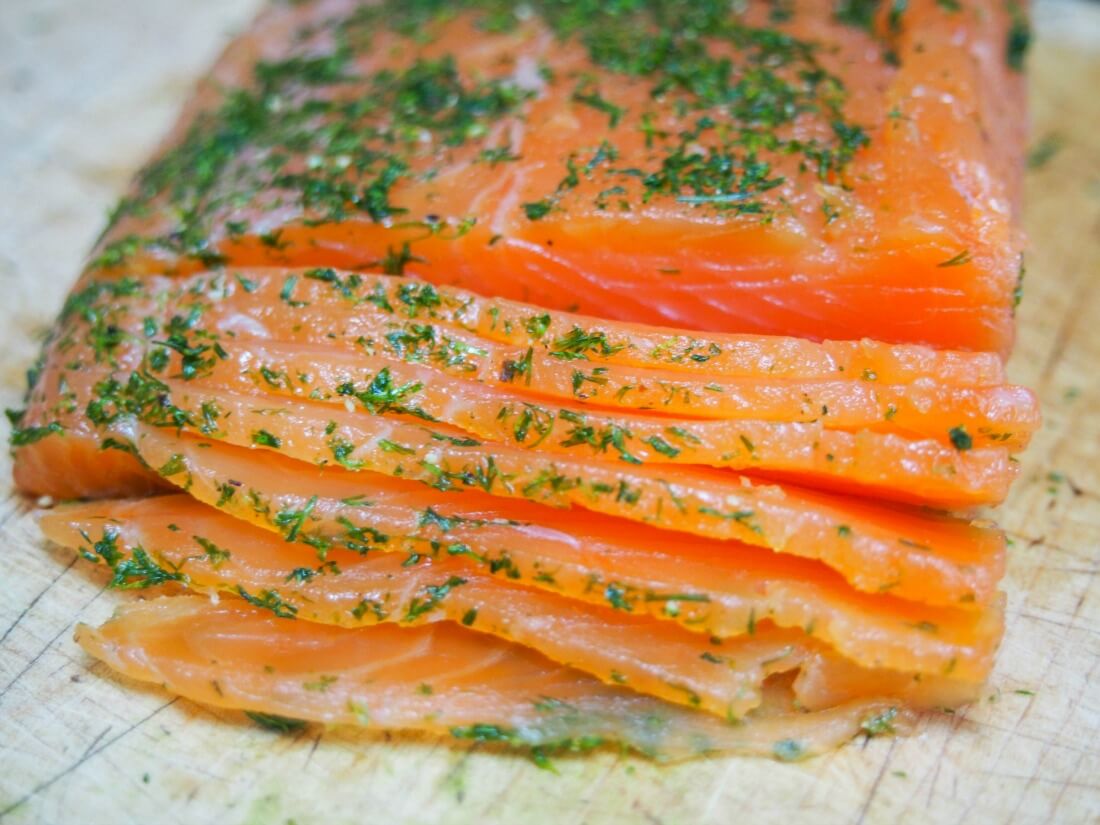
How to use salmon gravlax
Homemade gravlax is traditionally served with a mustard-dill sauce, gravlaxsås, with potatoes or rye bread. As mentioned, you'll find it on festive buffet tables, but it can also be used in many other ways.
- Put it on top of rye bread with some Danish remoulade sauce (as in my smørrebrød).
- Serve it with light, salad, such as with some winter greens.
- Roll it with cream cheese instead of smoked salmon in smoked salmon pinwheels.
- Use it much like smoked salmon, such as served on bagels, blini or on my smoked salmon pizza.
There really are many options! We've made it part of lunch with rye bread and remoulade. We've also made it part of a mix-and-match Nordic meal with Swedish meatballs, pressgurka (lightly pickled cucumber salad) and potato fritters.
Gravlax has a fantastic flavor and is so easy to make, it's a wonder it's not better known. And while similar to smoked salmon, some might even argue it's more tasty (I know my discerning kids do). Give it a try and see for yourself just how delicious it is.

Looking for more seafood appetizers? Try these!
- Scallops with cranberry bacon jam
- Hot phyllo crab cups
- Salmon tartare
- Scallop and chorizo stacks
- Plus see the appetizer recipes archives for more ideas.

Salmon gravlax
Ingredients
- 1 lb salmon fillet skin off or on, as you prefer
- ¾ oz dill tough stems removed and finely chopped
- 1 ½ oz sea salt semi-coarse is best, NOT iodized
- 1 ½ oz sugar
- ½ teaspoon black pepper freshly ground
- ½ lemon zest optional, ie from ½ lemon
Instructions
- If you have any doubt on the freshness/quality of your salmon, freeze it first then defrost it before making the gravlax to get rid of any bacteria. If it has been previously frozen or is sushi grade, no need to do this.
- Trim any thin pieces from your salmon. They will likely over-cure and are best used in some other way fresh. Carefully check to see if there are any bones and remove. Cut the salmon in two equal-sized pieces. This can be down the central spine if a wide fillet so you have in effect two squares.
- Remove the feathery leaves from the dill stems and finely chop them.
- Mix together the cure of salt, sugar, pepper, dill and lemon zest in a small bowl.
- Place one of the pieces of salmon, skin side down, in a freezer bag inside a dish just larger than the piece of salmon. Spoon most of the cure over the top and spread evenly.
- Place the other piece of salmon on top, skin side up. It should be the opposite way round from the bottom piece if possible (ie if bottom piece is thick on the left, have the other piece thick side to the left. Spoon over the last of the cure and rub that plus any cure that has escaped out the sides on the sides and over the top of the salmon.
- Close up the freezer bag and weigh down the top - for example put a heavy dish on top or a plate weighed down with something heavy (such as some cans). Place in the fridge and leave it to cure, turning every 12-24 hours, for 2-3 days until the salmon goes firm and slightly opaque.
- Rub off the excess cure (some stray dill is fine) and pat the fish dry. Slice the salmon thinly across the grain, removing any skin, and serve.
Video
Notes
Nutrition (per serving)
See some of my favorite cooking tools and ingredients in the Caroline's Cooking Amazon store.
This post was first shared in December 2015 and has been updated, primarily with additional information, new photos and added video.
Remember to pin for later!

Petra @ CrumblesAndKale says
This looks amazing, in Sweden this is a must on our "christmas table" as we call it. Have you tried adding shredded beetroot to the salt and sugar? Gives it an amazing color!
Caroline's Cooking says
Thanks Petra, yes I have seen it made with beetroot and it's on my 'to try' list, just haven't managed yet!
Ginger says
Wow - it looks simply stunning! I fell that I need to take some plating classes with you ...
😉
Caroline's Cooking says
Thank you, you are too kind!
Faye Wilkerson says
I have never make gravlax before. I don't care for pond raised salmon, but I will be on the lookout for a beautiful slice of wild-caught salmon so I can give this a try.
Caroline's Cooking says
Thanks, Faye, it's definitely worth trying - as well as wild salmon you can also try other fish as well.