
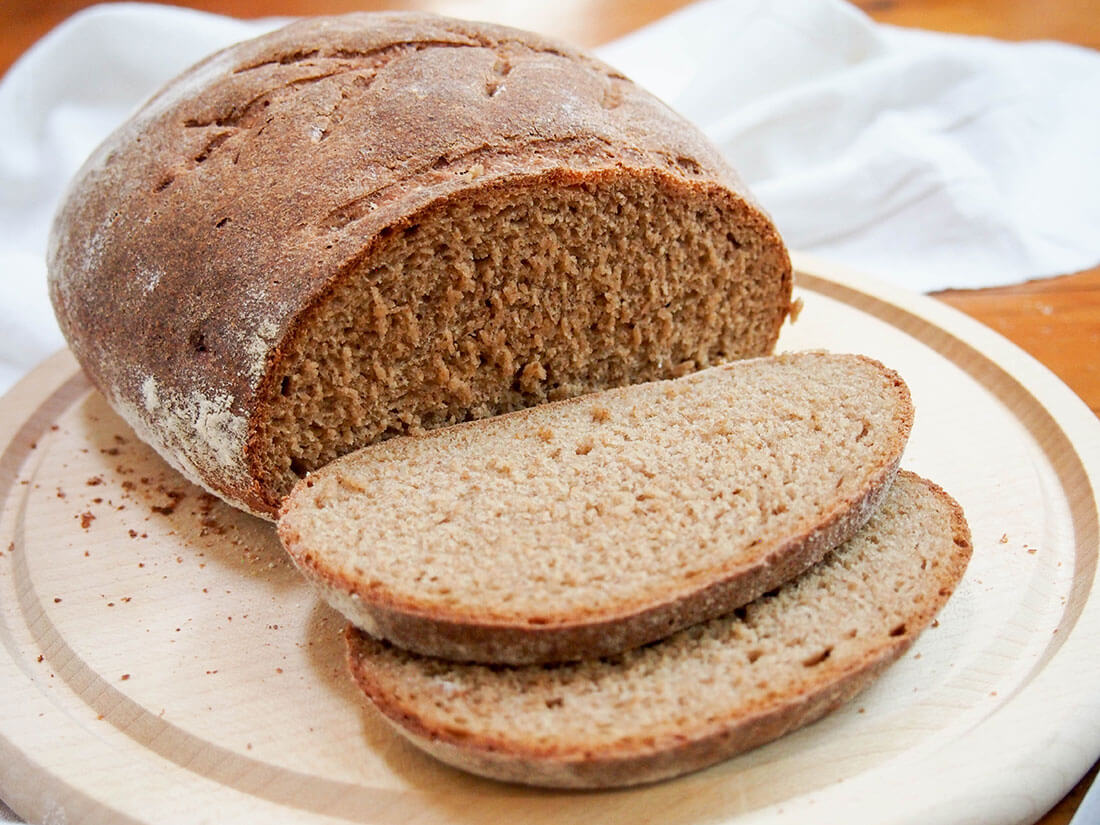
Rye bread comes in many shapes and sizes, and this sourdough rye bread is based on the German style "Mischbrot" using part rye and part wheat. It's a bit lighter than a full-on rye, but packed with wonderful flavor.
This post may contain affiliate links, where we earn from qualifying purchases. See more details in the policy page.
If you have ever traveled in Scandinavia, Germany or Eastern Europe, you have probably come across some of the darker bread available. Some are a deep almost chocolate color while others are lighter.
Where does the brown come from? Rye.

Rye used to be more commonly used across Europe but it was often considered the inferior grain to wheat, in part because it is lower in gluten so gives a denser loaf. The past issues of it getting a fungus, ergot, that was potentially fatal didn't help either.
However these days there are no longer the fungus issues and while it isn't as popular elsewhere, it is most definitely well loved in Northern and Eastern Europe. I remember living in Germany as a student and even the local supermarket had a huge bread counter with fresh bread in a dizzying range of varieties. I'd say around three quarters had rye at least in part.
Various trips to Sweden and Denmark have been similar, although maybe with a few less varieties but still a mix of pure rye bread and ones mixed part wheat and rye.

How does rye compare to wheat?
Rye has a lower glycemic index than wheat but it is still one of the grains that contains gluten. Being lower in gluten, it can be a bit hard to work with if you are using just rye. It doesn't have that "stretchiness" and it can be hard to get a good rise, if any at all. That's why a lot of 100% rye breads are very dense.
As a result, many loaves combine rye with wheat in various combinations (like a French country bread, pain de campagne). While wheat is higher in protein, rye has more fiber, so combining them you get some of the benefit of both, as well as it being easier to work with.

What are the ingredients in rye bread?
This can vary, but the core ingredients are rye flour, water and salt. In some cases, you will use yeast but with a sourdough rye bread like this you use a sourdough starter that has natural yeast.
As I mentioned, pure rye can lead to a very dense bread. Mixing rye with wheat flour, though, makes it a bit lighter and much better as an everyday bread. In fact the traditional French pain de campagne has just a little rye but it makes it a much more interesting flavor than plain wheat.
This loaf is still just part rye, but a higher proportion and you really get the flavor, especially as a sourdough, and the nutrition.

What distinguishes a German Mischbrot?
"Mischbrot" means "mixed bread" and is a term used for a loaf made with a rye and wheat flour mix.
In general, most German breads are sourdough, although this doesn't necessarily mean using a sourdough starter. It can mean making a "sponge" with yeast that then develops overnight. I'd call this more of a semi-sourdough.
Here, though, I have gone for a full sourdough using a starter that I can then also use for future loaves.

The stages in making sourdough rye bread
Let me get it out there: this isn't exactly a quick loaf to make. However none of the stages take very long or are difficult.
Step one: sourdough starter
The starter is the part that takes the most time overall, but it will take you literally a minute, if that, each time you tend to it. A sourdough starter basically involves combining flour and water into a paste and leaving it to ferment. You don't need to add yeast as it develops naturally from the flour and natural yeasts in the air.
Each day you add more water and flour and after a couple days it will start to bubble. The above is after 3 days, below after 5 when it is most definitely ready to use.
I used some tips from this sourdough rye starter article by using bottled (mineral) water slightly warmed in the microwave to be tepid. It worked just fine, though if you find your starter isn't bubbling, give it a couple extra days.
What do you do with the leftover starter?
You can keep the leftover starter and use it for future loaves or other baked goods - you can use the rye starter as you would a wheat one, it will just give a slightly different flavor.
If you don't need to use the starter again immediately, you can keep it dormant in the fridge. Then take some out to feed again a couple days before you next need it.
Time commitment: about a minute a day over 5 days

Step 2: sponge
The "sponge" is almost like a cross between the first rise of a loaf and a bigger starter. It is still a runnier mixture than the bread itself would be, but it is around half the volume of the loaf (though can be less).
A number of German Mischbrot (or similar breads) start at this stage and use yeast in with the flour and water rather than some of the sourdough starter. All you need to do is mix things together then give it the 24 hour rise.
What I found was that the mixture clearly grew in volume but didn't have any obvious bubbles on the top. However as you can see in the photo below, when you pulled back some of the mixture it had air pockets underneath.
Time commitment: about a minute then leave for 20-24 hours.

Stage 3: forming the loaf
The final stage before baking is adding the additional flours and forming the loaf itself. It's at this point that it goes from being all rye to part wheat. Sine there is some what I knead the loaf a little but it doesn't need much.
I have added a little molasses which isn't particularly traditional, although it is used in some loaves. You can miss it out as it's not all that much anyway, but I like to think it adds a little to the flavor.
After the slight knead, flour a bread basket or line a bowl with a clean cloth and dust with flour. Form the bread into a ball and put in the basket/bowl and cover for a final short rise. It should more or less double, but may not be quite as much as that.
Time commitment: 5 minutes before final 2 hour rise

After the final rise, dust a baking sheet with cornmeal and put the loaf on top. Score the top of the loaf slightly (ideally with a razor or lame, the name for the scoring tool but otherwise with a sharp thin knife). Leave it to sit while the oven heats up then put it in.
You want to have some steam in the oven to help it get a nice crust so I put a baking dish in while the oven heats and then put boiling water in it as I add the loaf.

This sourdough rye bread is a little heavier than a purely wheat loaf but with a lovely depth of flavor. A tight crumb but not too dense, gently nutty but not too sour. It keeps pretty well for a couple of days and is perfect for sandwiches, enjoying as toast or just to snack on.
There really is nothing quite like homemade bread and this one went down so well in our house.

Try these other homemade breads:
- Japanese milk bread
- Caramelized onion sourdough bread
- Tsoureki (Greek Easter bread, similar to brioche)
- Lemon thyme focaccia
- Sprouted wheat bread
- Plus get more German recipes in the archives.
You may find a proofing basket and lame helpful to make this recipe (affiliate link).
See some of my favorite cooking tools and ingredients in the Caroline's Cooking Amazon store.

Sourdough rye bread
Ingredients
For the sponge
- 4 tablespoon rye starter (see recipe below)
- 1 cup rye flour
- ½ cup water lukewarm
To make loaf
- 1 ½ cups bread flour
- ½ cup rye flour
- 1 teaspoon salt
- 1 tablespoon molasses
- ½ cup water lukewarm
Instructions
- Mix the sponge ingredients together in a bowl, making sure they are well mixed. Cover the bowl with a cloth or cling wrap/film and leave in a warm place for around 20-24 hours. You should see it noticeably grow in size and you may see bubbles form.
- After the rise, mix in the additional flours, salt, molasses and water. Tip the mixture out onto a floured surface and knead for a minute or two. It should be soft but not sticky.
- Dust a bread basket with flour or line a large bowl with a clean cloth and dust with flour. Form the bread into a ball and put in the basket/lined bowl. Cover and leave to rise another 2 hours.
- When ready to bake, dust a baking sheet with cornflour, put the loaf on top and score a couple of lines or a design with a razor/lame or sharp knife. Let it sit as you preheat the oven to 425F/230C (or a little higher if your oven will go higher). Put a small baking dish in the bottom of the oven and boil some water.
- When the oven has heated, put the loaf in on the baking sheet in the middle. Add some boiling water to the baking dish to create steam then close and bake for around 35 minutes, possibly slightly longer, until it is a nice even brown and is hollow sounding when you tap.
- Transfer the loaf to a cooling rack and allow it to cool before slicing.
Notes
Nutrition (per serving)

Rye sourdough starter
Ingredients
Day 1
- 2 ½ tablespoon rye flour
- ¼ cup water 52g/60ml, lukewarm
Day 2
- 2 ½ tablespoon rye flour
- ¼ cup water 52g/60ml, lukewarm
Day 3
- 2 ½ tablespoon rye flour
- ¼ cup water 52g/60ml lukewarm
Day 4
- 2 ½ tablespoon rye flour
- ¼ cup water 52g/60ml, lukewarm
Instructions
- On the first day, mix together the flour and water until it forms a thick paste, cover but loosely and leave in a warm place for 24 hours
- The next day, stir the mixture then add the additional flour and water. Mix them in, then cover and set aside overnight again.
- Repeat each day - by the third or fourth day it should be showing a good level of bubbles. It should be fine to use on the 4th day, but you can also feed again and use on the 5th day.
- After you have taken some out to use for the loaf, you can either feed again to keep it alive and then keep taking some out as you need it to use or as it gets too big. Alternatively, you can cover and let it 'sleep' in the fridge. Then when you need it, take some out, feed it in the same way as above and it should come back to life after a day or two.
Notes
Nutrition (per serving)
We're having a celebration of bread for World Bread Day today! See more tasty ideas:
- Bao Buns from Karen's Kitchen Stories
- Cheesy Garlic Sourdough Focaccia from Cooking with Carlee
- Chocolate Babka from Amy's Cooking Adventures
- Chocolate Bread from A Day in the Life on the Farm
- Sun Dried Tomato Pesto Dinner Rolls from Cooking for My Soul
- White Chocolate Mocha Braid from The Baking Fairy
- Yemarina Yewotet Dabo (Ethiopian Honey Bread) from Culinary Adventures with Camilla
Remember to pin for later!

Sherry Robertson says
My mom made the best rye bread I have ever tasted. Her family is German and she always used a sponge made with potatoes and the water. I still have the crock she used. When I tried it with a sponge, my house smelled like a brewery the next morning! My rye starter is going crazy so going to give this today! Will let you know how it turns out. The recipe sounds great though.
Caroline's Cooking says
Oh how interesting! I love hearing about family traditions like these, hope you like this take on rye.
Veronica says
I have learned that sourdough sponges when truly ready will float in the water and that is how you know it is ready to use. Your sponge does not float I have made 5 loaves and not once have they risen unless I add yeast. I have fed my sourdough starter everyday for three weeks and it is does float why isn’t the sponge floating?
Caroline's Cooking says
So a couple things to note on this recipe - first, it's a relatively low-rise rye in the first place, so is never going to have large air pockets as you might see in some other loaves. The other thing is the starter described here works fine if you are just making it for this recipe as it is basically a 'new' starter, but it is not what you typically do in terms of discarding some of the starter and so doesn't work to maintain it this way. If you intend to keep this starter going for longer before using or to use for additional loaves, you really need to be discarding some and feeding the remainder to keep a higher level of new 'food' for the yeast and also keep the pH balance of the starter. Typically you weigh the starter you are keeping and add the same weight of water and flour to it (so if, for example you have 100g starter, you add 100g flour and 100g (100ml) water). Hope these help.
Malou says
Hi, is there a substitute for molasses you would recommend? I'm not very fond of the black stuff. Many thanks. Your bread sounds great. I'll make a load as soon as I hear back. Cheers
Caroline's Cooking says
It won't be quite the same, but a bit of brown sugar should also work.