

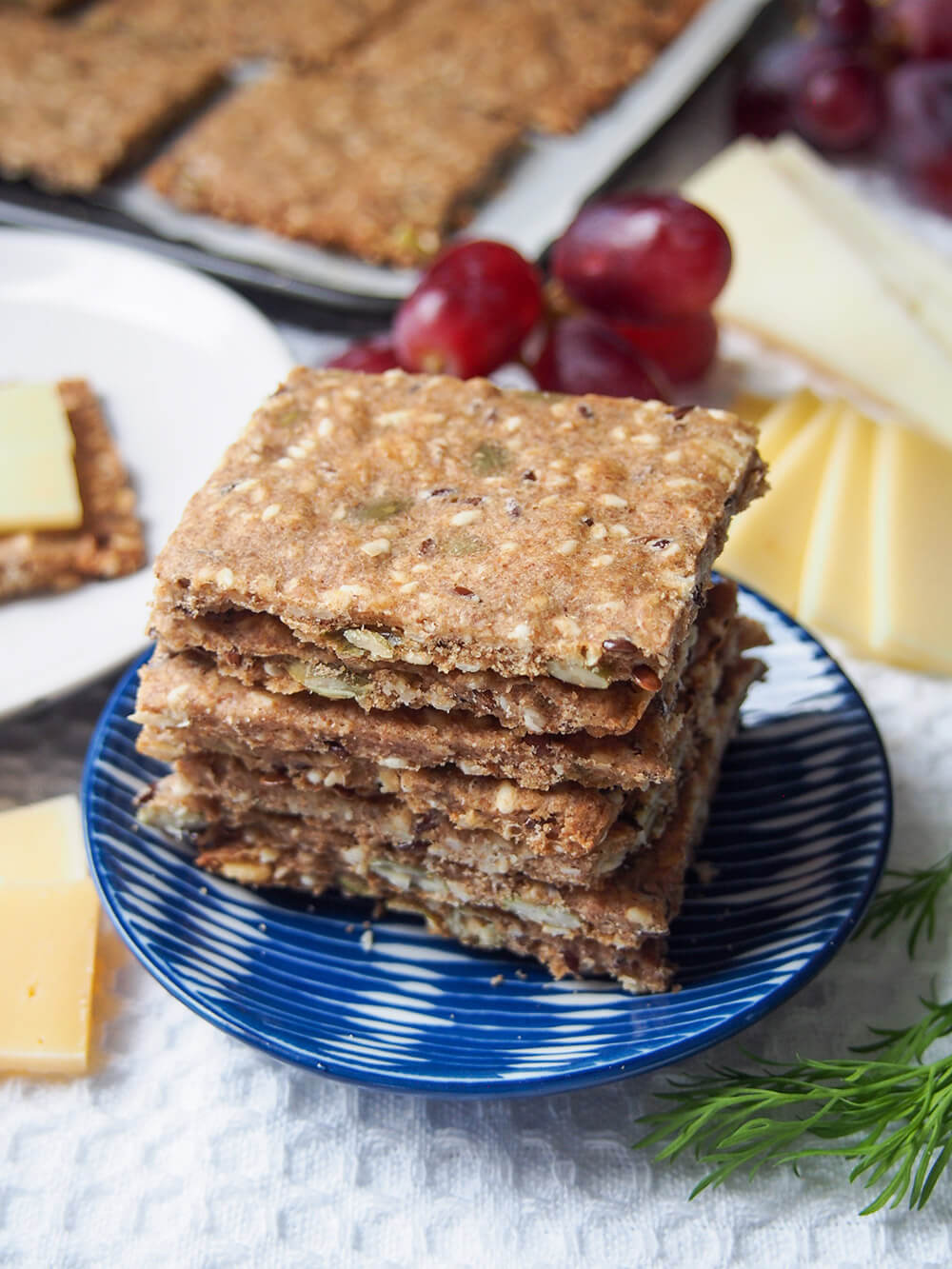
These Swedish crispbread are really easy to make and packed with good-for-you ingredients as well. You'll find variations of these rye seed crackers across Scandinavia as a crunchy snack or part of lunch.

This post may contain affiliate links, where we earn from qualifying purchases. See more details in the policy page.
I remember having bought crispbread when I was a child and to be honest, it wasn't something I was a huge fan of. You may know what I am talking about - the very dry, crunchy crackers that are often passed as diet food. If you didn't have a pretty soft topping, they were hard to eat.
Well, believe me these are so much better. I have had these at various points over the years from Norwegian, Danish and Swedish friends with slight variations. They are crunchy, with a nice mix of flavors from the seeds.

Where do crispbread come from?
These crackers go by many names, depending on where you are, such as knäckebröd in Swedish, knækbrød in Danish and knekkebrød in Norwegian translating as "crisp bread" as well as hårdbröd (Swedish) meaning "hard bread".
They are popular across Scandinavia, and also in Germany and other neighboring countries, but are believed to originate in Sweden some 500 years ago.
Originally they were made simply with rye flour, salt and water and were considered part of a poor person's diet. These days, they are more widely appreciated. They're great to add to a cheeseboard, pack for snacks and more.

While you'll still find plain crackers (particularly commercially), at home people typically add some seeds in to them. This both adds to the flavor and gives a nice texture. Plus, many of the seeds are pretty healthy.
Here I have gone with a pretty typical combination of seeds but one of the great things is they are easy to adapt. You can use other seeds you may have - sunflower seeds are also popular, and you could try poppy seeds as well, for example.
While rye is the traditional flour, some use wheat flour or a blend of rye with wheat or spelt. I would always include some rye, personally, partly as it has a great flavor but also it's a big part of the character of these crackers, to me.

Tips for making these crackers
Traditionally, people made these in a round shape with a hole in them, a bit like the shape of bagels, as you'd store them on a stick by the fire to keep them crisp. These days, however, making them square or rectangular is much more common (and easier).
One of the key things when you make these is to try not to overmix the dough. You want to just combine everything but little more. It helps to mix the dry ingredients first to limit how much you stir once you add the water and oil.

Then, use parchment both over and under the dough to roll it out. This save the dough sticking to your rolling pin. You can also use a silicone baking sheet underneath if you have one. Just make sure whatever you use, it fits in your baking sheet/tray so you know what size you are working to.
If it rolls beyond the underneath mat/paper size at any point, you can just trim the edge and stick the bit of dough onto an area that's shorter. Roll over it gently and it will soon stick.

Score the dough before baking. Some recipes cut right through, but the crackers can curl up at the edge sometimes. Scoring keeps them flat but still able to cut (mostly) to the same shape once cooked.
These Swedish crispbread are an easy and tasty combination of seeds and rye flour. They're great topped with cheese, pates and more, or simply as they are for a snack. So give them a try!
Try these other homemade crackers:
- Oatcakes (Scottish oat crackers)
- Homemade cheese crackers
- Whole wheat olive oil crackers
- Plus get more cracker and bread recipes and snack recipes in the archives.

Swedish crispbread (rye seed crackers, knäckebröd)
Ingredients
- 1 cup rye flour
- ½ teaspoon salt
- ¼ teaspoon baking powder
- ¼ cup rolled oats
- ¼ cup pumpkin seeds
- ¼ cup sesame seeds
- 2 tablespoon flaxseeds
- 3 tablespoon olive oil
- ⅓ cup water or a little more if needed
Instructions
- Preheat the oven to 400F/200C. Measure two pieces of parchment, or get a silicone mat and a similar-sized piece of parchment ready to fit a baking sheet/tray around 10x15in (25x38cm).
- Place the flour, salt and baking powder in a bowl and mix them together. Add the oats and seeds (pumpkin seeds, sesame seeds, flaxseeds) and mix so evenly distributed.
- Add the oil and water and combine until smooth. Take care not to overmix, you want it just combined. It should feel slightly stiff but still spreadable (add slightly more water if too stiff).
- Turn the mixture out onto the silicone mat or one piece of parchment and press the dough out to flatten a little. Top with the other piece of parchment and then roll out with a rolling pin to be around the same size as the piece of parchment. If it spreads beyond the area, you can trim a bit off and stick it to an area that has not spread as much. Then re-cover and roll over gently to help it join.
- Remove the top layer of parchment and carefully transfer the silicone mat/parchment to the baking sheet/tray. Score the top of the dough to make squares or rectangles of the size you want the crackers to be - I got around 24.
- Place the baking sheet/tray in the oven and bake for around 20 minutes until the top if dry and firm and the edges are just starting to become darker.
- Leave the crackers to cool a minute or two then cut along the score lines to break into crackers.
Video
Notes
Nutrition (per serving)
See some of my favorite cooking tools and ingredients in the Caroline's Cooking Amazon store.
Remember to pin for later!
Cristina Furlong says
I am excited for this recipe. I had a Norwegian one that came out good for a while, then I bombed. Maybe because rye flour varies a lot? Anyway, ai think this firat try will be dry, as I couldnt "spread" like you wrote.i had a dense ball. But its so easy and simple I will quickly try again. Thanks
Caroline says
Indeed, I think rye flours can vary a bit regionally, so it can sometimes take a bit of adjusting. When I say spread, it is still relatively dry and stiff but it should still work to roll it out with a bit of pressure. If not then yes, you may need to add a little extra liquid.
Leora says
the nutrition information - is that per 100 grams or what?
Leora says
continuing question on nutrition info: if it's per cracker, then IDK how close the size of my cracker is to yours. or did you mean the amount for the entire batch, weighed after baking, divided by 24? This is important to me for my diet.
Caroline says
Hi, so the nutritional information is per serving, which in this case is 24. So if you get more or less crackers from the batch yu may need to adjust accordingly. The nutritional information is also always estimated.
CAYLA says
I will definitely be making more of these! I left out the flax seed because I didn’t have any and I used black sesame seeds. The dough was super easy to work with, they came out perfectly at 20 mins and came apart really nicely. I’m excited to try more combinations. Thanks! This recipe is a keeper!
Caroline says
I'm so glad! Indeed, they're definitely open to variation with different seeds etc.
Leora says
Very tasty and healthy, but I found the dough very hard to work with. I doubled the recipe and it took me an hour or so to roll it out, it kept being uneven, ragged edges, too thick. also the dough was crumbly, kept falling apart. Any advice? what did I do wrong? I would give 5 stars if it was easy to work with the dough.
Caroline says
Glad you enjoyed the taste! So on texture, it sounds like maybe you needed just a bit more liquid in there - did you weigh or use volume measurements, as weight is always more accurate. I'd suggest maybe using either slightly less flour or adding a little more water and/or oil to make the dough slightly more smooth. It should still be on the drier side compared to say a bread dough, but not super crumbly either. Also, if you are making double, I'd suggest dividing then just rolling half at a time. Rolling a large amount of dough is always more difficult so the smaller amount should be easier to work with. Hope that helps!
sean kinsey says
i make a sourdouogh rye german vollkornbrot with similar grain bill, and sometimes have 300-500g surplus dough at bake time. will definitely be making that into crackers now with your help. thank you.
Caroline says
Sounds like a great idea, indeed Volkornbrot has a lovely mix.
Katherine A. Nelson says
I've made this recipe several times and I love it, the only problem is, I can't stop eating them. I add a little bit of ground caraway and fennel seed to mine, (personal preference) and they are great and so healthy to boot. Thank you!
Caroline says
So glad to hear you have been enjoying them, and indeed some fennel/caraway seeds can be tasty in there.