
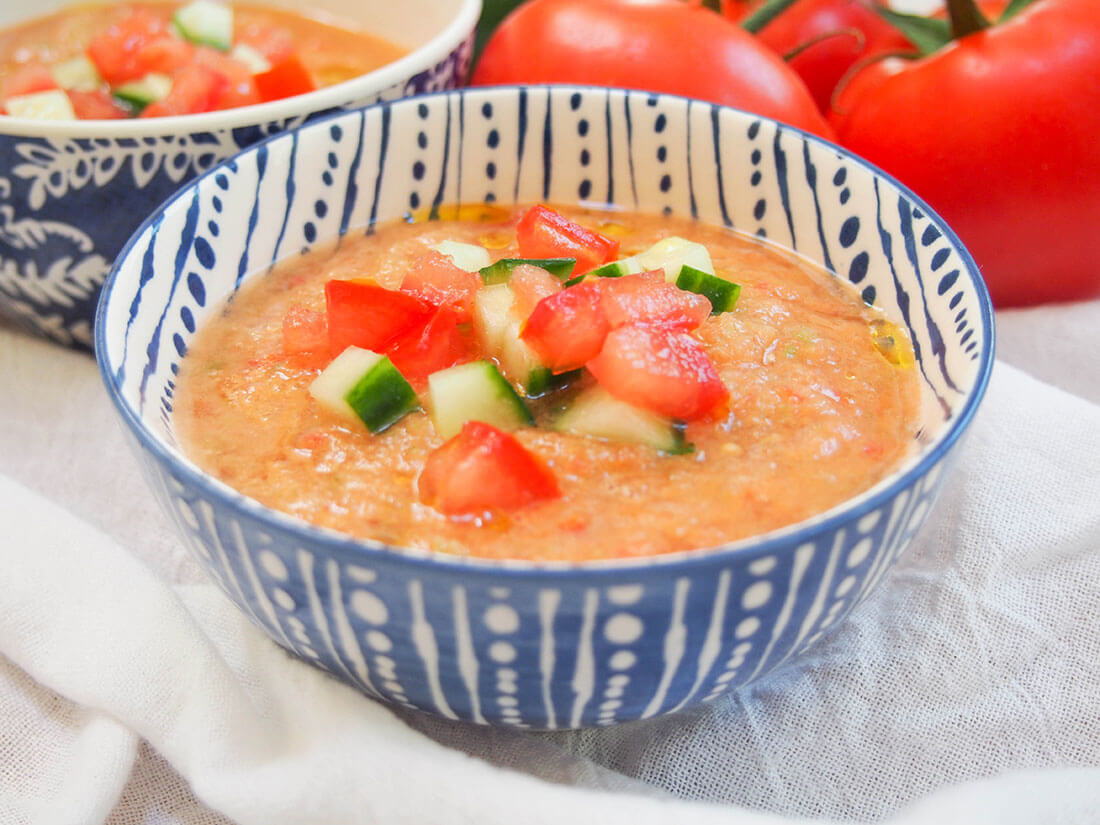
This traditional Spanish gazpacho is quick to make with just a few ingredients and is wonderfully refreshing on a hot summer's day. This flavorful cold soup is a great way to enjoy fresh tomatoes at their peak.
This post may contain affiliate links, where we earn from qualifying purchases. See more details in the policy page.
I will always remember the first time a friend showed me how to make gazpacho when I was living in Spain. My contribution was to pick up ingredients for this and pan con tomate. But I was a novice on ingredient-picking at the time.
I naively got some nice looking tomatoes for the bread, then some slightly cheaper but OK-looking ones for this, thinking they were mixed in so it would matter less. I was so wrong.
My friend rejected my average tomatoes and used the best ones for the gazpacho. Then raided her cupboards for any extra she had to use as few of the less-good ones. You see, gazpacho may be simple but it's all about the ingredients, so quality matters. Which arguably is true for many Spanish recipes.

Origins of gazpacho
Gazpacho is a cold soup that is particularly popular in Andalusia in Southern Spain, where the summers can get very hot. There is some debate about the exact origins, with some saying saying it has it's roots in the bread, garlic and oil carried by Roman soldiers. But most agree it's Andalusia where it became popular.
The earliest versions of gazpacho were simply bread, oil, vinegar, garlic, salt and water, believed to have evolved during the Moorish Al-Andalus period. The dish was a way to get some nutrition out of a small number of ingredient and eaten by people who worked the land.
An early variation was another cold soup, ajo blanco, made with almonds, which arrived in Spain before the main ingredients in modern-day gazpacho. It wasn't until the 16th century that tomatoes and peppers were brought back from the New World and gradually the gazpacho we now know evolved.
These days, the classic gazpacho known around the world is essentially the Seville-style. In Cordoba, another cold soup, salmorejo, is more common which is thicker and more predominantly made with tomatoes.

These days, you'll find many modern gazpacho variations which add various other ingredients in the mix. Some of the more common are watermelon, cantaloupe, beet or green gazpacho. Yet the classic pepper and tomato version is still such a great one that's well worth enjoying through the warmer months.
Gazpacho ingredients
You only need a handful of ingredients for this classic gazpacho recipe:
- Tomatoes - use the best quality you can get. In Spain, Roma tomatoes are often used but other varieties also work well. You want really fresh, ripe tomatoes with a good flavor. This is definitely a dish to make in peak local season. There's no need to peel the tomatoes, but remove any tough core from them.
- Cucumber - an English style or the small Persian-style cucumbers are best here to have a good flavor and limited bitterness.
- Green pepper - I'll admit, I'm not usually the largest fan of green pepper but it is the classic ingredient here and does have more flavor. In Spain you often get the longer peppers that are closer to Cubanelle which also work.
- Shallot/onion - this is not in all versions - and actually more common in Jerez than Seville - but does add a nice extra layer of flavor, if you wish to add.
- Garlic - like tomato, a key part of many Spanish dishes that adds a punch of flavor since it's raw, but it does meld in with the other ingredients so don't worry about it taking over.
- Bread - some modern versions skip this for a slightly lighter soup but it's a core part of the traditional soup and helps make it thicker and gives a slightly creamy texture. To work best, you want to remove the crust and soak the bread in some water first.
- Vinegar - sherry vinegar is the classic choice in Analusia, being from Jerez, but red wine vinegar also works well. This adds a little extra acidity and flavor.
- Olive oil - go for a good quality one here, extra virgin and Spanish if at all possible. Spanish olive oil has a great relatively bold flavor so adds a lot of flavor.
- Salt - just a little helps bring out the flavors. You can also add a little black pepper as well.
The key is to choose good quality ingredients for the best end flavor.

Preparing ahead
While the basic preparation is little more than chopping and blending, one key part of making this cold soup is it needs time to chill for the flavors to mingle well.
While it does mean you need to wait, the upside is it's perfect to make ahead for entertaining. It's easy to make this in a large quantity - make in batches if needed. I usually make this in a blender to get it pretty smooth, but a good food processor or hand blender can also work.
You can make it a day or two ahead of when you need it without any impact on flavor. In fact, some argue it gets better. Just keep it refrigerated until you are ready to serve.
How to serve
You can serve this in a few different ways, depending on what works best for you. If it's more of an appetizer or light meal, I would serve in bowls and like to garnish with some diced tomato and cucumber for added crunch. A little drizzle of a good olive oil adds a little extra flavor as well. Some, especially outside Spain, like to add croutons, but personally I prefer sticking with vegetables to keep it fresher and lighter.
The other option is to serve in a glass, such as small shots to be part of an appetizer selection or alongside tapas (like as in my cold Spanish tapas meal). Alternatively, you can serve it more as a drink over ice, particularly on really hot summer days.

This classic tomato gazpacho is a wonderfully tasty, refreshing and easy dish that's just the thing on hot days. It's easy to prepare, light and good for you too. So grab your ingredients, get blending and enjoy.
Try these other easy Spanish tapas:
- Spanish pintxos (easy to make, these topping-loaded pieces of bread have infinite options, with a few favorites and classics in this post)
- Gambas al ajillo (Spanish garlic shrimp, so tasty and a tapas classic)
- Spanish cheese plate (get lots of ideas for cheeses, cured meats and side nibbles to try for delicious Spanish-style grazing)
- Plus get more Spanish recipes in the archives.

Gazpacho
Ingredients
- 1 slice bread crusts removed
- 1 lb tomatoes
- ½ green pepper
- 6 oz cucumber (6 oz is approx ½ English cucumber)
- 1 shallot or ¼ small red onion, optional
- 1 clove garlic
- ½ tablespoon sherry vinegar or red wine vinegar
- 1 ½ tablespoon olive oil recommend extra virgin
- ¼ teaspoon salt plus optionally, a little black pepper
Instructions
- Pour a little water over the bread to help it soften as you prepare the other ingredients.
- Roughly chop the tomatoes, removing any tough central core. De-seed and roughly chop the pepper. Peel and roughly chop the cucumber, onion and garlic then place all in a blender, along with the bread (squeeze out any excess water first).
- Blend until smooth then stir in the vinegar, oil and salt. Taste and adjust seasoning to taste, with a little more salt, some pepper or a little more vinegar as you prefer. If it's bitter (eg if the tomatoes are not as ripe), a pinch of sugar can help but only a small amount. Refrigerate at least an hour or until ready to use.
Video
Notes
Nutrition (per serving)
See some of my favorite cooking tools and ingredients in the Caroline's Cooking Amazon store.
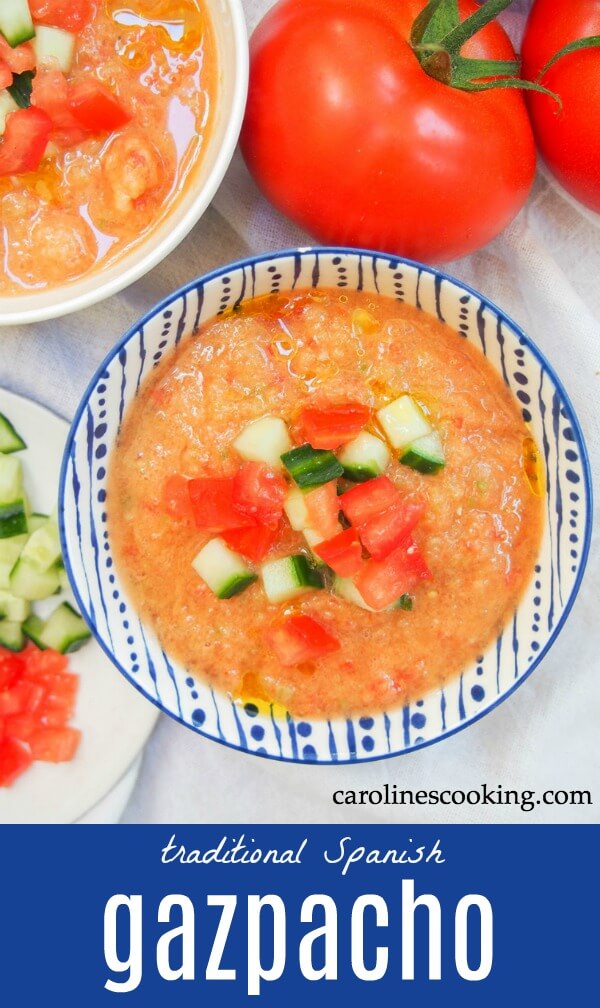
Remember to pin for later!
Clive says
Back from Spain hols where we loved this, but it's hard to find gazpacho over here in the UK, so will attempt my own.
Q - Once peeled, do you remove the seeds from the cucumber?
Caroline says
I don't typically remove the seeds as I tend to use the smaller Persian/Lebanese cucumbers that have small seeds and so they always seem to blend well. But if the seeds are large, you might want to remove them.
Mike Filkins says
I remove all the tomato seeds, and cut the cucumbers in such a way to remove seeds. Seeds are bitter so removing them improves final flavor. Also, I use a high quality sherry vinegar.
Caroline's Cooking says
Indeed, a good vinegar does help. And you can certainly remove the seeds if you prefer and/or if you know your cucumber has more bitter seeds - with an English or Persian/Lebanese cucumber this is less likely as the seeds are much smaller and generally less bitter. I don't recommend using a cucumber with the larger seeds such as those for pickling in part as generally more bitter but also I don't find the flavor as good, but I appreciate you can't always get the other types. On tomatoes, it's really up to you, removing seeds can lead to wasting quite a bit of the juices, depending how you do it, so it really depends on the tomato.
Liz @ Books n' Cooks says
Such a wonderful, light summertime appetizer or lunch!
Caroline's Cooking says
Thanks, it really is!
Anne says
I would love a bowl of this right now. Beautiful pictures too!
Caroline's Cooking says
Thank you!
Ellen says
The perfect summer soup!
Caroline's Cooking says
Indeed it is!
Karen says
This looks delicious. I need to make this during this raging heatwave!
Caroline's Cooking says
Thanks, it would be perfect for the heat.
Jolene says
So fresh and perfect for the unbelievably hot summer we've been having!
Caroline's Cooking says
Thanks, that was exactly why I made it again recently!
Valentina | The Baking Fairy says
I can't believe I've never made gazpacho before! I had no idea it was so simple and I love that it's naturally vegan!
Caroline's Cooking says
Thanks, I agree it's surprisingly simple and so good.
Hilda says
I love your authentic gazpacho recipe. I agree with you - simple is better. Not quite gazpacho season here yet, although the tomatoes won't be long, and the cucumbers are raging.